






What AI Cannot Run Without
The debate surrounding artificial intelligence is changing. It’s no longer about whether the technology works.
AI capabilities are improving faster than the physical world around it can be rebuilt. This creates opportunities for investors.
Nvidia CEO Jensen Huang put it plainly in August:
AI has become useful. And the AI agents that are being adopted everywhere use an enormous amount of compute.
That usefulness is showing up in corporate disclosures. Microsoft told investors this summer that one in three pull requests on its code hosting website GitHub involves an AI agent.
None of this happens without semiconductors. The chips are doing what they were designed to do rather faster than expected, and the AI models themselves are improving at a rapid pace. But AI is now moving from answering questions to doing work, and doing work requires power.
Why Improving Capabilities Becomes A Physical Question
Better models are more useful models. More useful models are used more widely. And every use case consumes electricity.
OpenAI CEO Sam Altman has described where this ends:
…the cost of intelligence should eventually converge to near the cost of electricity
This is also increasingly describing where capital is being deployed.
The Half of the Story That Is Already Well Understood
The sums being invested in AI infrastructure are nothing short of eye-watering. The International Energy Agency reports that capital expenditure by large technology companies now exceeds global investment in oil and natural gas production.
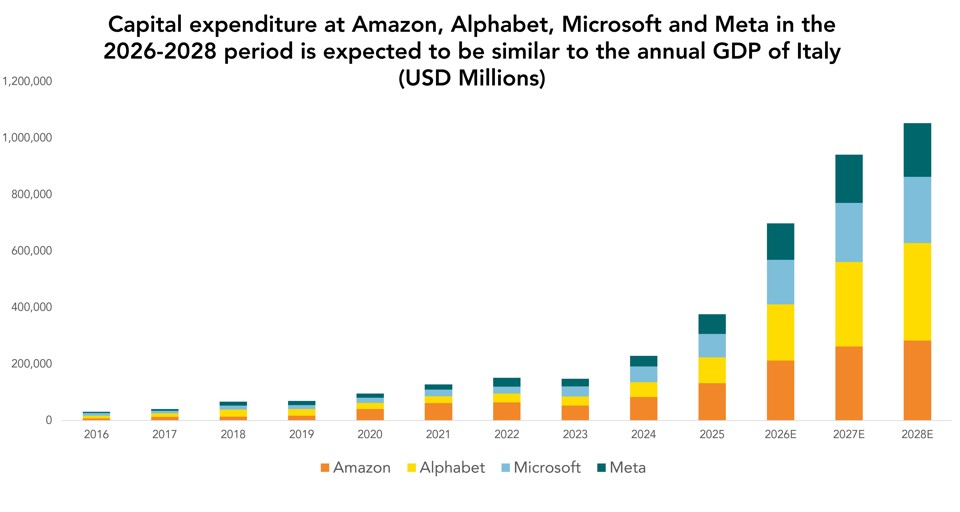
Source: Refinitiv, In-house Direct Equity Research. E= Consensus estimates
A large share of this spending is on semiconductors, which remains the most direct expression of the AI investment theme.
Less well understood is the rest of the bill. On one estimate of a gigawatt-scale AI data centre, servers account for 60% of the total cost of ownership. The other 40% represents everything else needed to make those servers work at all.
And this part of the bill creates opportunities for investors.
AI is Consuming More Power, Chips are More Efficient, and it is Still Not Enough
Each generation of AI chip draws more power than the last. Nvidia’s A100 accelerator was specified at 400 watts, Blackwell is 1,000 watts, and its successor, Rubin, is anticipated to draw even more power. The International Energy Agency expects the power density of AI servers to rise fourfold again by 2027: a single rack, roughly the size of a large household refrigerator, could soon draw the peak power of 65 homes.
Efficiency is improving too. Testing measured the latest systems delivering more than ten times the tokens per watt compared to previous generations. The IEA finds that energy usage per AI task is falling by at least an order of magnitude a year.
It’s still not enough. Total consumption is still climbing. Data centre electricity demand grew 17% in 2025. Demand from AI-focused facilities grew by 50%.
Microsoft CEO Satya Nadella named the mechanism – as AI becomes more efficient and accessible, its use will skyrocket. Economists call this ‘The Jevons Paradox’. Counter-intuitively, increases in efficiency are leading to greater overall demand for power.
Why it matters
Projected data-centre electricity supply, 2024 to 2030
of modern data-centre electricity use attributed to servers
of incremental demand expected to be met by renewables through 2030
The Constraint is Physical
The clearest testimony comes from the companies selling the silicon.
Nvidia CFO Colette Kress told investors in February that every data centre is power-constrained.12 Broadcom CEO Hock Tan was more specific in September, describing land, power and data centre shells as a constraint that limits when AI capacity is deployed. 13 Microsoft CEO Satya Nadella has described holding processors he cannot deploy for want of warm shells to plug them into.
Regulators paint the same picture. In Great Britain the queue for grid connections has grown from 41 gigawatts to 125 gigawatts, with data centres accounting for at least 80 gigawatts of this increase (though we note some of this demand may be speculative).
These are not software timelines. An electricity substation cannot be compressed.
Where the Opportunity Broadens
Follow the electricity from the generator to the chip and the shape of the wider opportunity becomes clear.
It begins with generation. The IEA expects half of the global growth in data centre demand to be met by renewables, supported by storage and the wider grid, alongside gas turbines ordered years ahead of delivery and renewed interest in nuclear, with the first small modular reactors coming online around 2030.
It runs through transmission and distribution. The substations, transformers, switchgear and cabling carrying power from the grid to the building. At gigawatt scale, as much as 40% of power can be lost before it even gets to the compute, largely due to cooling inefficiency and overprovisioning. Electrical engineering has become a competitive variable rather than a routine one.
And like all electricity, it ends in heat. An advanced AI facility must dissipate heat equivalent to c.30 natural gas boilers for every rack.Air cooling alone is insufficient, and water-based systems are becoming increasingly complex. Cooling alone can account for from 7% to 30% of a facility's electricity use, depending on design.
Around all of this sit the networks connecting these sites, the utilities supplying them, the contractors building them, and the financing required to fund assets at this sort of scale.
Electrification, cooling, grids, utilities and infrastructure financing are not adjacent to the AI theme. This is where the physical world meets the digital. And it is an area we see opportunities today.
Not All Opportunities Are Created Equal, and the Picture is Changing Rapidly
None of this is assured. Large capital cycles do not distribute returns evenly. Execution risk is real, financing conditions change, and valuations move ahead of delivery.
The thesis is contested. For example, the International Energy Agency’s own ‘Headwinds Case’ has demand growing much more slowly than in its base case.
At Quintet we monitor hyperscaler capital expenditure, data centre construction, power and grid orders, and how these convert into earnings. The view changes when the evidence changes.
The race to create the most capable AI model is highly competitive, and model supremacy is both fleeting and uncertain. What is far less uncertain is what these models run on.
The chips will get plugged in. The question is – who gets paid before they do?
This document is designed as marketing material. This document has been composed by Quintet Private Bank (Europe) S.A., a public limited liability company (société anonyme) incorporated under the laws of the Grand Duchy of Luxembourg, registered with the Luxembourg trade and company register under number B 6.395 and having its registered office at 43, Boulevard Royal, L-2449 Luxembourg (“Quintet”). Quintet is supervised by the CSSF (Commission de Surveillance du Secteur Financier) and the ECB (European Central Bank).
This document is for information purposes only, does not constitute individual (investment) advice and investment decisions must not be based merely on this document.
Whenever this document mentions a product, service or advice, it should be considered only as an indication or summary and cannot be seen as complete or fully accurate. All (investment) decisions based on this information are at your own expense and at your own risk. It is up to you to (have) assess(ed) whether the product or service is suitable for your situation. Quintet and its employees cannot be held liable for any loss or damage arising out of the use of (any part of) this document. All copyrights and trademarks regarding this document are held by Quintet, unless expressly stated otherwise. You are not allowed to copy, duplicate in any form or redistribute or use in any way the contents of this document, completely or partially, without the prior explicit and written approval of Quintet. See the privacy notice on our website for how your personal data is used (https://www.quintet.com/en-gb/gdpr).
The contents of this document are based on publicly available information and/or sources which we deem trustworthy. Although reasonable care has been employed to publish data and information as truthfully and correctly as possible, we cannot accept any liability for the contents of this document.
Investing involves risks and the value of investments may go up or down. Past performance is no indication of future performance. Any projections and forecasts are based on a certain number of suppositions and assumptions concerning the current and future market conditions and there is no guarantee that the expected result will ultimately be achieved. Currency fluctuations may influence your returns.
The information included is subject to change and Quintet has no obligation after the date of publication of the text to update or inform the information accordingly.
Copyright © Quintet Private Bank (Europe) S.A. 2026. All rights reserved. Privacy Statement