Looking back at Quintet Private Bank’s first Women’s Night
This page presents an English translation of an article originally published in French by ELLE on 29 April 2026. The original article can be found here: Retour sur la première Women’s Night de Quintet Private Bank - ELLE.lu Luxembourg. Quintet Private Bank is not the author of the original piece. The translation below is provided for informational purposes only.
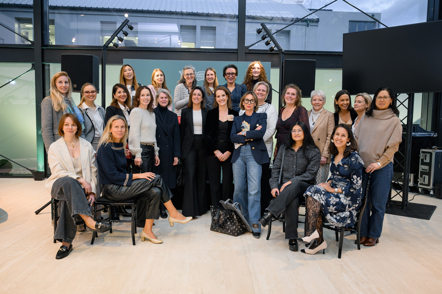
On March 31, Quintet Private Bank launched the first edition of its Women’s Night, a series of conferences dedicated to women. For this inaugural event focused on freedom, the bank brought together its guests for a discussion led by author Emmanuelle Hutin, alongside Nora Lemhachheche, Market Head France and Benelux at Quintet Luxembourg, and Constance Bastiani for ELLE Luxembourg, the media partner of the event. The gathering took place at Aston Martin (Louyet Group), a partner of the private bank.
Emmanuelle Hutin opens the discussion with a question that lingers for a few moments in the room: “What are, today, our spaces of freedom?” A starting point that, through situations, memories, life paths, and gestures, allows everyone to rethink their own approach to freedom. Driven by Emmanuelle Hutin, the conversation unfolds along three intersecting lines of force: what allows us to imagine freedom, what allows us to experience it, and what each person does with it in their life, their work, and their choices.
Imagining in order to act
The first shift comes through narratives. Emmanuelle Hutin begins with a simple observation: before being put into action, freedom must first have been thought about, desired—almost like a mantra. To support her point, she quotes Murielle Szac: “Before putting one’s liberation into action, one must have dreamed it, and only literary characters provide such mirrors.” In her argument, the figures of Gabrielle Chanel and Claude Cahun—whose lives she partly retraces in Les Francs-Tireuses (published by Gallimard)—serve this precise function. Gabrielle Chanel for what she transformed in clothing, in movement, and in the way a woman—and especially her body—occupies space. Claude Cahun for her work on identity, self-portraits, self-displacements, and the capacity to break free from assigned roles. Emmanuelle Hutin adds other, more intimate narratives, particularly those she read about motherhood at a time when her son’s illness disrupted the framework of her own life. It is at this moment that she introduces the concept of “learned helplessness,” developed by Martin Seligman and Steven Maier, to describe everything that is internalized without being questioned, everything that limits choices even before they are formulated. “The stories of others allowed me to unlearn this helplessness,” she says. Far from adding yet another injunction toward freedom, this idea invites us to observe what, in a trajectory, an upbringing, or an environment, immediately narrows the field of possibilities. In Les Francs-Tireuses, she expresses this same movement differently, based on Claude Cahun’s life: “Since freedom cannot be imposed—and this is the very paradox of the struggle for it—Claude could only encourage them to desire it.”
The body as a field of experience
The question of freedom is then explored through the body in all its materiality. Emmanuelle Hutin again starts from specific experiences. She recounts her years working for the Chanel house, her research on Gabrielle Chanel, her own relationship with her “uniform” at the time—pencil skirts and ten-centimeter heels—and the contradiction she now sees in it. She describes a trip to Japan, during which trying on a traditional kimono made her concretely experience what constraint does to the body. The layers of fabric, the rigidity of the garment, and the limited range of movement alter her posture, her mood, and even the way she speaks. “I realize that my body is suffocating, and as it suffocates, so does my mind.” The experience makes her understand the absurdity of aspiring to a form of freedom while living in clothes that restrict both body and mind.
Further on, she shares another, far more intimate memory: a separation, a road westward, children in the back seat, and a physical sensation that arises before any analysis. “I am alone behind the wheel of this car, and I am alone behind the wheel of my life.” Freedom manifests itself concretely in this release of breath, this ribcage loosening—an experience registered by the body even before the mind grasps it. Then Emmanuelle Hutin speaks of her son’s illness, which introduces another dimension to the discussion, both harsh and deeply felt. Long-term plans disappear, control no longer organizes daily life, and the present moment takes over. Once again, the body remains the anchor point. “Through yoga, I discovered the freedom of my body, and then that of my breath.” Bodily freedom then transforms into emotional, psychological, and even spiritual freedom. She connects this to a statement by Julia Kristeva: “The free mother has not yet been born,” opening another layer of the topic—one of the contradictory expectations placed on women, on bodies, and on the availability they are assumed to provide.
This passage from the body to freedom finds immediate resonance in the other interventions. Nora Lemhachheche, placed at the heart of the evening by Quintet Private Bank, reflects on a recent experience in the Moroccan desert: the absence of connection, silence, sand, the vastness of the sky, and the simultaneous feeling of smallness and intensity. Constance Bastiani, for her part, speaks about crossing the Strait of Gibraltar by swimming, then Lake Geneva—about losing bearings, the mass of water beneath her body, and a very clear sensation of stripping down. Two accounts that highlight how each of them brings freedom back to very physical, grounded situations, far removed from general formulas or notions of performance. One idea becomes even clearer: freedom is, above all, a physical experience. It passes through the body—through what it endures and what it can finally release—but also through the way it inhabits the world, moves within it, breathes, and feels.
Paths, choices, and uses
The final line of force of the evening concerns the concrete uses of freedom in work, life paths, and decisions over time. Nora Lemhachheche embodies this first through her own journey. Born in Algeria, raised and educated in France, she soon moved to Luxembourg to begin her career in private banking. She then left for London to create a family office for one of her clients, before returning to Luxembourg in 2011. She joined Quintet Private Bank in 2020, on the eve of COVID. Within this carefully built path, Nora emphasizes a sidestep she chose to take in 2018 by obtaining a vocational certificate in aesthetics, prepared alongside her professional responsibilities, with the idea of eventually opening a salon. “It was far more important than my previous degree because it had real meaning—it was chosen.” The use of the verb “to choose” is anything but trivial; it becomes a recurring theme throughout the evening. Choosing a training path, choosing to step outside one’s usual logic, choosing a profession, choosing another skill. At Quintet Private Bank, she connects this idea to daily work with clients and to how the institution supports women entrepreneurs, heirs, and investors. “Quintet continues to work actively on this and can offer tailor-made solutions.” It is also within this framework that she mentions the creation, at the end of the pandemic, of the Luxembourg Women’s Network, in response to the need to rebuild connections between colleagues, raise issues, share journeys, and then roll out certain initiatives at the group level. The group is headquartered in Luxembourg and has 1,600 employees, around 700 of whom are in the Grand Duchy.
At the opening, David Favest, Brand Director for Aston Martin, Lotus, and Jaguar Land Rover at the Louyet Group, briefly welcomed the guests by offering an initial echo of the evening’s theme: in the world of customization, freedom can also lie in the way each individual appropriates an object and projects their own story onto it.
Freedom as an open question
At the end of the discussion, Emmanuelle Hutin revives the reflection with another question: “What would you do with 10% more freedom?” The discussion then shifts scale. One man speaks about the loss of freedom in everyday life, constant controls, and an accumulation of rules. Emmanuelle Hutin responds by bringing the question back to its most concrete dimension: freedom remains relative, subjective, and context-dependent, and perhaps one should start by recognizing the freedom that remains rather than focusing only on what is lacking. A particularly powerful contribution comes from a guest who connects the evening to her personal story. Born in Angola to Portuguese and African parents, she explains that she experienced very early on what it means to live without freedom, in a context of war, militias, and fear. She describes how this past continues to shape the way she lives today—continuing to work, to get up, to get dressed, and to move forward. Her words bring an additional, necessary gravity to the evening. Freedom ceases to be a purely valorizing term and becomes once again not only a matter of context, memory, and survival, but also of transmission.
Finally, Emmanuelle Hutin leaves the audience with one last quote from Claude Cahun, allowing the reflection to continue:
“Freedom, love—it is all one. At least for me, for I know only how to merge them. To lose or to gain through the other, and reciprocally… It is a movement akin to that of my heart: it speaks of that source, it leads back to it.”