


Introduction
The circular economy represents a fundamental shift away from the traditional “take–make–waste’’ model. By focusing on reuse, recycling and resource efficiency, it enables companies to reduce environmental impact, improve resilience, and unlock new economic opportunities. As regulations tighten and global supply chains evolve, circularity is becoming a competitive advantage and an investment opportunity.
WHY INVEST IN THE CIRCULAR ECONOMY?

Learn how the circular economy can drive economic growth by creating new business opportunities and jobs, supported by intelligent design, smart manufacturing and innovations that enable waste and energy avoidance.

Get a clear view of how circularity reduces waste and supports sustainability goals, as more than 1,000 organisations commit to ambitious targets such as eliminating unnecessary plastic packaging and increasing recycled content.

Find out how circular solutions strengthen resilience by reducing dependence on fragile supply chains, especially for critical raw materials essential to the energy transition, a key focus of the EU’s Critical Raw Materials Act.

Understand why the circular economy scores highest in sustainability within our thematic portfolio and contributes across demographic shifts, geopolitical fragmentation and technological progress, adding diversification to traditional allocations.
Let’s talk about investing in circular economy
These exclusive insights explore the sectors, innovations, and long‑term trends shaping the global circular‑economy landscape.
To receive advice and to become a client of Quintet Luxembourg, you must have a minimum of €1M of investable assets.
The circular economy is a transition away from the traditional “take‑make‑waste” linear model toward a regenerative system designed to continually reuse resources. It focuses on durability, repairability, and recyclability, aiming to eliminate waste and reduce environmental impact while preserving valuable materials.
The circular economy addresses major global challenges such as environmental degradation, resource scarcity, supply chain instability, and rising regulatory pressures. Companies adopting circular practices can achieve greater resource efficiency, lower operational risks, and benefit from strong demand for sustainable solutions, making circularity a compelling long‑term theme for investors.
The global market for circular economy solutions is projected to grow from USD 690 billion* in 2024 to USD 2,882 billion* in 2031, representing annual growth of around 22%. This expansion is driven by regulatory support, supply chain reshoring, sustainability targets, and technological innovation, including AI‑enabled tools such as predictive maintenance that extend asset lifespan and reduce waste.
* Source: kingsresearch
Beneficiaries include companies involved in:
- Innovative design and materials, such as alternatives to plastics and sustainable construction inputs.
- Waste management and recycling, enabling material recovery and resource security.
- Industrial software and predictive maintenance, which extend the life of physical assets and reduce operational waste.
- Localised manufacturing and reshoring, as firms seek greater visibility and resilience in supply chains.
Challenges include:
- Dependence on shifts in regulation and sustainability targets.
- Geopolitical fragmentation, which can disrupt access to critical raw materials.
- The need for infrastructure scaling, such as recycling capacity and new material technologies.
- Differing levels of circularity adoption across industries, which may influence competitive positioning.
The circular economy is not just a theme; it’s a new way of extraction, production, conception, and consumption.
Alexandra Spasov – Funds Solution Analyst & Thematic Research, Quintet
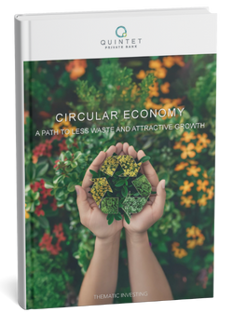
Download our Guide
Our guide offers clear insights, explaining what you need to consider and how circularity reshapes business models, resource use and long‑term investment opportunities.
Learn more about:
-
Economic Benefits: unlocking growth through innovation & resource efficiency
-
Environmental Impact: reducing waste and supporting sustainability goals
-
Resource Security: addressing geopolitical and supply chain pressures
-
Why the Circular Economy is in our thematic model portfolio
Important Information
-
Investing puts your capital at risk.
-
The value of your investments can go down as well as up, and you could lose some or all of the money invested.
-
Tax treatment depends on individual circumstances and is subject to change.
-
Tax planning is not regulated by the Commission de Surveillance du Secteur Financier.