

Alexandra Spasov on AI, Robotics and the Investment Themes Shaping the Next Decade
6 mins to read this article

What you need to know
- Artificial intelligence is creating investment opportunities far beyond headline technology stocks, particularly in cybersecurity, data centres, energy infrastructure and robotics.
- As AI accelerates demand for computing power, electrification, renewable energy and grid modernisation are becoming critical themes for long-term investors.
- Successful thematic investing requires looking beyond market hype to identify the structural trends and real-world needs that could shape economies over the next decade.
Traditional investing is a map. Thematic investing is a compass. One tells us where the world is today; the other helps us think about where it may be heading over the next decade.
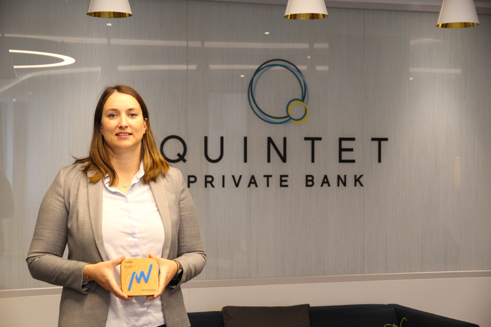
The Citywire 40 Under 40 award winner discusses AI infrastructure, cybersecurity, clean energy and how thematic investing helps identify tomorrow's opportunities today.
You were recently recognised by Citywire as one of Europe's leading young fund selectors. Looking ahead, which investment themes do you believe will create the most significant long-term wealth opportunities for private banking clients over the next decade, and why?
Very few technologies arrive with the potential to reshape the global economy. Artificial Intelligence is one of them. It will transform our society much as digitalisation did, creating significant new investment opportunities. I believe the most durable opportunities will emerge from the infrastructure required to support this transformation.
In particular, I see strong long-term potential in four interconnected themes: cybersecurity, electrification infrastructure, renewable energy, and physical AI. As AI becomes embedded across the economy, cybersecurity becomes essential to protect increasingly connected systems. At the same time, the rise of AI is driving unprecedented demand for electricity, on top of the current electrification of our world, requiring massive investment in power grids, transmission networks and energy storage.
Renewable energy also has a critical role to play, not only because it supports decarbonisation goals, but because it is increasingly one of the fastest and most cost-effective ways to add new generation capacity within your own soil.
Finally, what excites me most is physical AI: the combination of robotics and artificial intelligence. Humanoid robots may still be in their early stages, but over the next decade they could help address labour shortages and transform industries ranging from manufacturing to healthcare. Beyond improving productivity, humanoid robots may also help address demographic challenges. As populations age and households face increasing time pressures, having intelligent robots taking over routine tasks such as household chores could free up more time for what matters most: family, leisure, sport and personal wellbeing. It may sound futuristic today, but many of the technologies that shape our lives once did. For wealth management clients seeking long-term growth, AI infrastructure, cybersecurity and robotics represent some of the most compelling secular investment themes of the coming decade.
Much of the market's attention remains focused on headline AI winners, but you've highlighted the importance of investing across the entire AI value chain. Which less obvious opportunities, such as infrastructure, cybersecurity, robotics or energy, do you currently find most compelling for sophisticated investors?
The biggest opportunities often lie in the bottlenecks rather than the headlines. When everyone focuses on the obvious winners, I often find the more durable opportunities further down the value chain.
Today, AI adoption is constrained by two fundamental needs: energy and infrastructure. Data centres, cloud computing and AI inference require enormous amounts of electricity, creating significant demand for power generation, transmission networks and grid modernisation. Without these investments, the expansion of AI becomes much harder.
Cybersecurity is another area I believe remains underappreciated. As more devices, businesses and critical infrastructure become connected, the attack surface expands dramatically. At the same time, AI is giving malicious actors increasingly sophisticated tools. Demand for advanced cybersecurity solutions is therefore likely to grow regardless of the broader economic environment.
I also continue to find robotics particularly interesting. While the theme remains volatile and relatively early in its development, advances in AI are accelerating the capabilities of autonomous systems. For investors with a long-term horizon and tolerance for volatility, robotics could become one of the most important beneficiaries of the next phase of AI adoption.
Data centres, cloud computing infrastructure and cybersecurity solutions are becoming critical pillars of the AI economy.
As Thematic Research & Funds Solutions Analyst at Quintet, how does your day-to-day research process help you identify genuine long-term opportunities while avoiding themes that are driven more by marketing hype than by sustainable fundamentals?
My role gives me the opportunity to speak with portfolio managers, industry specialists, academics and company executives across a wide range of sectors. Each brings a different perspective on how the future might evolve.
The challenge is distinguishing between a compelling narrative and a sustainable investment theme.
To do that, I take a broad, multidisciplinary approach. I analyse trends through economic, technological, societal and environmental lenses and ask a simple question: what is the world likely to need in ten years that it may not yet need today?
Rather than focusing solely on short-term market enthusiasm, I look for structural forces that can persist for years, sometimes decades. If multiple independent trends converge around the same conclusion, and if real-world constraints suggest increasing demand for a product or service, that is usually where I become most interested.
Much of my research starts with curiosity. I spend a significant amount of time reading outside traditional financial sources, from technology journals to academic research and demographic studies.
Ultimately, thematic investing is about identifying the building blocks of the future rather than chasing the story of the moment.
You've spoken about the growing importance of electrification and clean energy, particularly as AI drives unprecedented demand for power and infrastructure. How are you currently assessing the clean energy opportunity, and what should long-term investors be watching most closely?
For many years, clean energy was viewed primarily through a sustainability lens. While sustainability remains central, I believe the investment case has broadened considerably.
One of the biggest misconceptions is that clean energy is only about sustainability. Increasingly, it is becoming a question of economic resilience and national competitiveness.
Because Europe is a net importer of oil, it is strategically important to have our own source of energy, and the European Commission's recent competitiveness and decarbonisation agenda further strengthens this direction, with electrification positioned as a key pillar of Europe's industrial and economic future.
As a result, investors should not only focus on renewable generation itself, but also on the broader electrification ecosystem. Grid infrastructure, energy storage, transmission networks and power management technologies may prove just as important as solar panels or wind turbines.
Your role requires you to constantly anticipate future trends and innovations. Outside of markets, what motivates you personally, and how has your own curiosity shaped the way you approach investing and identifying tomorrow's opportunities?
As a child, I was fascinated by imagining what daily life would look like in fifty years' time. That curiosity never really left me.
My interest in history has taught me that major transformations often start as niche breakthroughs. The steam engine, electricity, the internet and smartphones all began with limited adoption before reshaping how people live and work. At the same time, science fiction has sharpened my curiosity about the future trends by encouraging me to imagine how today’s emerging technologies could become tomorrow’s everyday realities.
Those personal interests naturally led me to thematic investing, which helps me connect seemingly unrelated trends and identify the companies, industries and ecosystems that could benefit from long-term structural change.
To conclude, I would describe traditional investing as a map: it helps us understand where companies and economies stand today. Thematic investing is more like a compass: it forces us to think about where the world is heading and what will be needed along the way.